


U.S., Europe Fall Behind in the Race to Control the Arctic
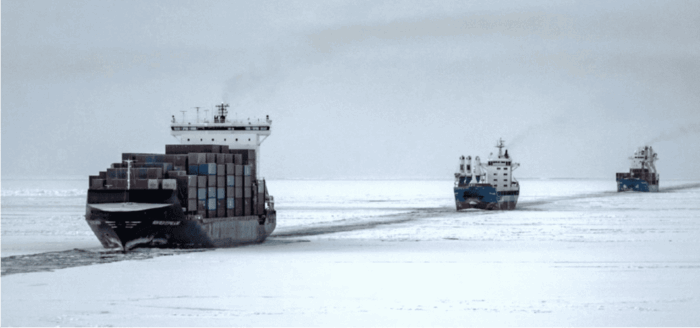
The Arctic has become a central strategic region as melting ice—occurring at nearly four times the global average rate—opens new shipping routes and facilitates access to energy and critical minerals. This shift has intensified geoeconomic competition among major powers over control of resources, rules, and trade corridors that will shape global markets for decades.
Russia clearly dominates the Arctic due to its geography and the concentration of resources. Approximately 80% of Arctic oil and gas production comes from Russian territory, and Arctic fields account for around 20% of Russia’s oil output, with an even larger share of its export growth potential. The region holds 35.7 trillion cubic meters of natural gas, nearly 75% of Russia’s proven reserves, more than the rest of the Arctic combined. In addition, Russia’s Arctic territories contain 95% of its platinum group metals, two-thirds of its rare earth reserves, 100% of its nickel, and 92% of its cobalt production. This resource base has enabled Moscow to maintain a presence in Asian markets despite Western sanctions.
Following the 2022 invasion of Ukraine, Russia redirected its energy flows toward Asia using the Northern Sea Route (NSR), which nearly halves travel time between northern Europe and Asia compared with the Suez Canal. Arctic crude and condensate are increasingly shipped east via a growing “shadow fleet,” while Yamal LNG continues to reach both Asian and European buyers. However, the EU’s decision to ban all Russian LNG imports starting January 1, 2027 will further increase the NSR’s importance for Moscow. The Arctic has also become a testing ground for sanctions evasion through ship-to-ship transfers and opaque ownership structures.
China, while having a smaller physical presence, has secured a strategically significant position. Chinese companies hold nearly 30% of the Yamal LNG project, supported by state banks as part of a $27 billion investment. This ensures long-term LNG supply, access to polar energy technology, and optionality in future Arctic shipping routes. Beijing has also sought stakes in rare earth projects in Greenland and iron and nickel resources in the High North—materials critical to clean-energy supply chains. The “Polar Silk Road” strengthens China’s trade resilience against disruptions in the Red Sea, the Suez Canal, or the Strait of Malacca.
By contrast, Western Arctic resources are more fragmented. Alaska accounts for about 3.5% of total U.S. crude oil production, Sweden’s Kiruna region hosts the EU’s largest rare earth deposit—potentially supplying up to 18% of the bloc’s demand—and Finland is set to become the EU’s first integrated lithium producer. Greenland holds vast critical mineral potential, though logistical challenges make large-scale investment unlikely in the short term.
Overall, competition over Arctic resources and shipping routes is already having structural effects on global markets. More concentrated control of Arctic sea lanes could fragment international trade, turning the High North into a standalone corridor with its own rules, costs, and political risks—making the Arctic a new critical pressure point for global supply chains.
Comments are closed here.