


Höegh Autoliners orders the world’s first ammonia-powered PCTC engines
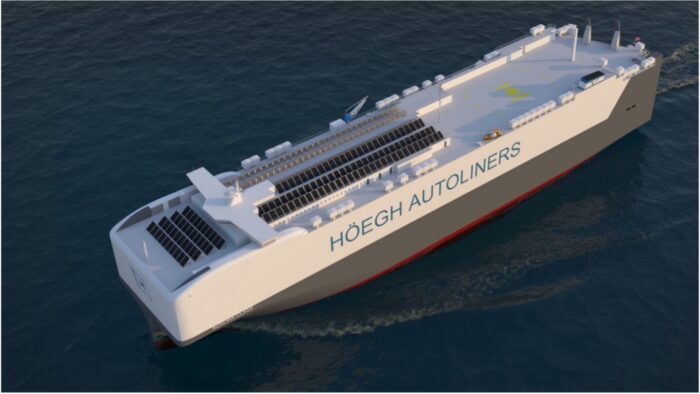
Höegh Autoliners has placed a landmark order for ammonia-burning engines to power its newest vessels, marking a significant step forward for maritime decarbonization efforts.
The company has ordered four 7S60ME-LGIA (liquid ammonia gas injection) dual-fuel engines from German manufacturer Everllence, which will be installed in its 9,100 CEU ‘Aurora’ class Pure Car/Truck Carriers (PCTC).
The engines will be manufactured by HD Hyundai Heavy Industries in South Korea and delivered to an undisclosed Asian shipyard for installation on ships. This order marks one of the first commercial applications of ammonia propulsion technology on large ocean-going vessels.
“Engines are at the heart of our vessels, and we consider it a clear sign of confidence that Everllence has chosen us to install some of the world’s first two-stroke ammonia engines on our last four Aurora-class vessels,” said Sebjørn Dahl, Chief Operating Officer of Höegh Autoliners.
Höegh Autoliners has advanced its green fleet renewal program with orders for 12 Aurora multi-fuel vessels at China Merchants Heavy Industry’s shipyard in Jiangsu, China, representing a significant advancement in the PCTC segment.
The Aurora-class vessels will initially operate on liquefied natural gas (LNG), biofuels and low-sulphur oil. However, Höegh Autoliners had planned for the last four of the 12 Aurora-class vessels to run on clean, environmentally friendly ammonia, which could reduce emissions by almost 100%. The first vessel of this class, the Höegh Aurora, was launched in August 2024.
The Norwegian shipping company has set ambitious decarbonisation targets, with Dahl confirming its “goal to operate our large PCTC vessels on carbon-free fuels from 2027”.
Bjarne Foldager, head of Everllence’s two-stroke engine business, said the order is part of a wider initiative, saying it is “one of several ammonia pilot projects we have in China, Japan and South Korea”.
“We have taken a responsible and safety-first approach when developing this engine due to ammonia’s particular risk profile, and we are confident that ammonia will eventually become one of the top three alternative fuels on the market alongside methanol and methane,” added Foldager.
Everllence, formerly MAN Energy Solutions, has been developing ammonia drive technology for several years. “We have been using our two-stroke ammonia test engine since 2023 and can confirm that the combustion of the ME-LGIA is what we want,” said Christian Ludwig, the company’s Director of Sales and Promotion of Two-Stroke Engines.
Ludwig explained that the engine design leverages proven concepts from its existing dual-fuel engines, which have been in commercial operation for more than a decade. “Inspired by these engines, among other innovations, we used the same sealing oil design for the fuel amplifier injection valves, as this has proven to be particularly important and efficient.”
“By the end of 2026, we tentatively expect to have a small number of demonstration projects on the water to enable the commercial market introduction of the G50, S60, G60, G70 and G80 caliber ME-LGIA engines based on a positive service experience,” Ludwig added.
With carbon-neutral ammonia, these vessels will reduce carbon emissions per vehicle transported by up to 58% compared to the current industry average. According to Höegh Autoliners, they will be the largest and greenest PCTCs ever built, setting a new standard for more sustainable offshore transport. The vessels have received DNV’s certifications as compatible with ammonia and methanol, positioning them as pioneers in the transition to alternative fuels.
Ammonia has emerged as a promising carbon-neutral fuel option for the maritime industry thanks to its potential to significantly reduce greenhouse gas emissions compared to conventional marine fuels. However, this fuel presents unique handling difficulties due to its toxicity, which has required the careful approach to engine development described by Everllence executives.
The maritime industry continues to explore various pathways to decarbonization in response to increasing regulatory pressure and corporate sustainability goals.
Everllence, headquartered in Germany, employs approximately 15,000 people at 140 plants globally. The company focuses on propulsion, decarbonization and efficiency solutions for maritime, energy and industrial applications, with the motto “Zero Big Things”.
Comments are closed here.